

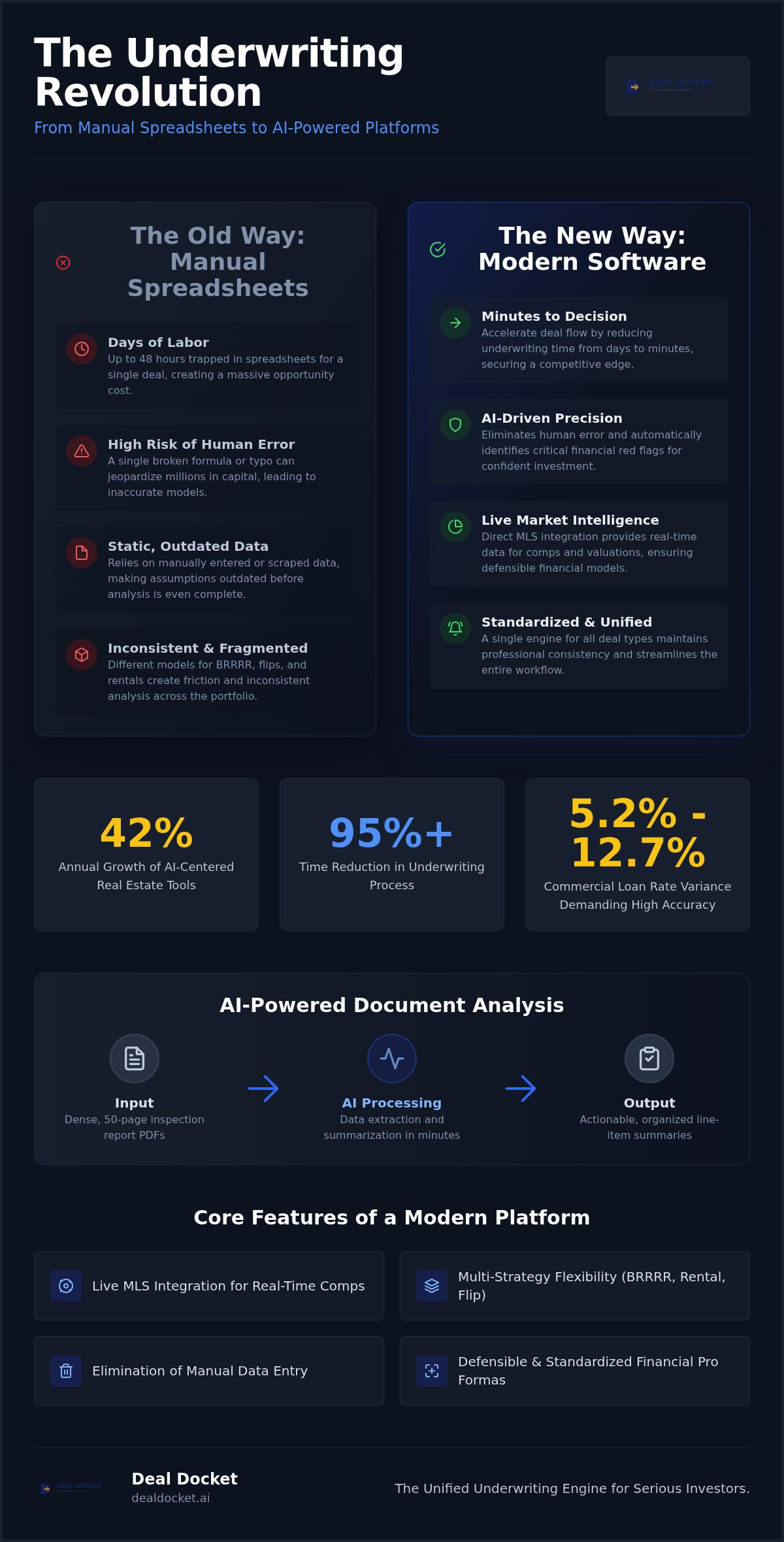
What if the only thing standing between you and a high-yield acquisition is the 48 hours you spend trapped in a spreadsheet? In a market where AI-centered tools are growing at 42% annually, the traditional manual approach isn't just slow; it's a liability. You likely agree that spending hours on data entry or missing critical red flags in a 50-page inspection report is a recipe for burnout and missed margins. Relying on inconsistent analysis across BRRRR and flip deals creates friction that your competitors have already solved with modern real estate underwriting software.
This article demonstrates how the right platform eliminates manual labor and accelerates your deal flow with AI-driven precision. You'll discover how to reduce your underwriting time from days to minutes while standardizing your entire due diligence process. We'll explore the technology providing instant access to live market data, ensuring your financial models are defensible, accurate, and ready for action in the high-velocity 2026 landscape.
Key Takeaways
- Modern real estate underwriting software transforms a multi-day manual process into a lightning-fast verification that secures your competitive edge.
- Integrate live MLS data and real-time market intelligence to eliminate the guesswork from comps and property valuations.
- Standardize your analysis across BRRRR, rental, and fix-and-flip models to maintain consistency and professional precision.
- Convert dense, 50-page inspection PDFs into actionable line items in minutes using AI-driven summary tools.
- Transition from manual spreadsheets to a unified engine that accelerates deal flow while identifying critical financial red flags.
Beyond Spreadsheets: The Evolution of Real Estate Underwriting in 2026
The 2026 real estate market doesn't wait for manual calculations. Speed is the new currency. The Underwriting process has shifted from a back-office chore to a front-end competitive advantage. Investors who rely on outdated methods find themselves outbid by those utilizing modern real estate underwriting software. This technology doesn't just calculate numbers; it verifies deal viability instantly. It provides the defensible data required to secure institutional capital or private lending in a high-interest environment. With AI-centered tools growing at 42% annually as of May 2026, the shift to automation is no longer optional. It's a requirement for survival.
Transitioning from static spreadsheets to dynamic software platforms is about more than just convenience. It's about reliability. In a landscape where commercial loan rates range from 5.22% to 12.75%, your margins are thinner than ever. You need a finished, defensible product rather than raw, unverified data. Modern platforms offer a streamlined solution that satisfies the professional need for accuracy while meeting the market's demand for velocity.
The High Cost of Manual Data Entry
A single broken formula in a hidden cell can jeopardize millions in capital. Manual entry is a breeding ground for catastrophic human error. Beyond the risk of inaccuracy, there's the massive opportunity cost. Every hour you spend on manual data entry is an hour you aren't spent finding the next deal. This creates a psychological toll. Cluttered, complex spreadsheets lead to analysis paralysis. You hesitate because you don't trust your own math. Automation replaces this friction with professional confidence, allowing you to move from inquiry to action without the weight of traditional bottlenecks.
Why 2026 Investors Are Abandoning Legacy Calculators
Legacy calculators are static and isolated. They lack live MLS integration, which means your assumptions are often outdated before you even finish the model. Modern real estate underwriting software solves this by providing a unified source of truth for the entire acquisition team. Static tools simply can't handle the complexity of modern BRRRR or fix-and-flip strategies that require real-time market intelligence. In 2026, successful investors demand a platform that integrates live data directly into their financial models. This ensures your pro formas are based on current market reality, not last month's guesses. You gain a competitive edge by presenting lenders with a robust, interconnected analysis that stands up to scrutiny.
Core Features to Demand in a Modern Underwriting Platform
Modern real estate underwriting software must do more than just crunch numbers. It acts as your command center for deal velocity. In 2026, the baseline has shifted. You don't just need a calculator; you need an integrated ecosystem that pulls live data and pushes out defensible pro formas. The goal is to eliminate the friction between finding a property and making a confident, data-backed offer. Relying on fragmented tools is a recipe for missed opportunities and inconsistent analysis.
Efficiency requires a unified workflow. Your platform should handle everything from initial screening to deep-dive due diligence without requiring you to export data to a third-party spreadsheet. This level of integration ensures that your team moves faster, stays accurate, and remains focused on high-value tasks rather than manual data entry.
Live MLS Integration vs. Scraped Data
The critical difference between success and failure often comes down to the freshness of your data. Most legacy tools rely on scraped information, which creates a lag that kills deals in fast-moving markets. Real-time MLS integration allows for instant market intelligence. You can filter properties using the 1% Rule in seconds rather than hours. This level of precision is vital for assessing risk potential before you commit capital. Automating the comps process removes the most labor-intensive part of your workflow. It turns a half-day research project into a three-minute verification. You get the "why" behind the numbers instantly, allowing you to move with professional confidence.
Multi-Strategy Flexibility: One Tool, Every Deal
Serious investors don't stick to a single model. Your software shouldn't either. You need the ability to switch between rental analysis and fix-and-flip projections with one click. Modeling a complex BRRRR scenario requires accounting for the initial purchase, the rehab phase, and the eventual long-term refinance. A unified platform standardizes your criteria across every asset class, whether you're looking at a single-family rental or a multi-unit flip. This consistency ensures your team stays aligned on what constitutes a "buy" signal. By centralizing your real estate underwriting platform, you ensure that every deal is measured against the same rigorous standards, regardless of the strategy involved.
Cloud-based accessibility rounds out the essential feature set. It ensures this data is available to your entire acquisition team instantly. No more emailing version 5 of a spreadsheet or wondering if the local pro has seen the latest inspection summary. Everyone works from the same source of truth. This transparency accelerates the approval process and ensures that when you finally pull the trigger on a deal, it's based on the most accurate, collaborative data available.
Speed vs. Accuracy: Why Automation Wins in Fast-Paced Markets
Traditional real estate wisdom suggests a trade-off between speed and accuracy. You either move fast and risk a mistake, or move slowly and miss the deal. In 2026, this is a false choice. High-performance real estate underwriting software solves this paradox by replacing manual processes with algorithmic precision. Automation removes the friction between identifying a lead and making a firm offer. It ensures that every deal undergoes the same professional rigor without the delays inherent in human-led analysis. By the time a traditional analyst opens their spreadsheet, an automated investor has already submitted a defensible offer based on live market intelligence.
The "Velocity Advantage" is clear. Analyzing more opportunities per hour directly correlates to closing more deals per year. This isn't just about doing more work; it's about increasing the quality of your output. Automated verification reduces the risk of overlooking critical financial red flags that often hide in the margins of complex deals. You gain the ability to scale your portfolio without scaling your headcount or sacrificing your standards.
Eliminating the "Manual Tax" on Analysis
Calculate the hours your team spends on data entry each month. For most firms, this "manual tax" consumes 20 to 30 hours per analyst every week. This time isn't just lost; it's a barrier to growth. Speed creates a powerful ripple effect across your entire network. Wholesalers and agents prioritize the investors who respond the fastest. If you can provide a "yes" or "no" in minutes, you become the first call for every off-market opportunity. Underwriting Velocity is the key metric for 2026 growth. It represents the total number of qualified properties an acquisition team can move from raw lead to a finalized, defensible offer within a single business day.
Accuracy Through Algorithmic Consistency
Algorithms don't suffer from fatigue or bias. While a tired analyst might overlook a thin margin or a miscalculated cap rate, real estate underwriting software catches these discrepancies instantly. This shift is mirrored in the broader financial sector, where AI's transformation of lending has already redefined how institutional players evaluate risk. By using automated filters like the 1% Rule, you can discard bad deals in seconds and focus your energy on the winners. This consistency builds a defensible pro forma that lenders and partners can trust. When your numbers are backed by an objective, data-fed engine, you present a level of professional confidence that manual calculators simply cannot match.
Streamlining Due Diligence: From Inspection Reports to Final Pro Formas
Due diligence is the phase where deal momentum typically grinds to a halt. You've verified the market and the comps, but the physical state of the asset remains an expensive mystery until the inspection report arrives. In the high-velocity 2026 market, a 50-page PDF is a liability that kills momentum. Modern real estate underwriting software solves this by treating the inspection as a data source rather than a static document. It extracts the financial implications of a property's condition and integrates them directly into your pro forma. This transition from raw data to a polished investment summary ensures that your final offer is grounded in physical reality, not optimistic guesses.
Efficiency in this stage requires a move away from manual review. When you automate the extraction of repair items, you eliminate the friction between the inspection and the final negotiation. This isn't just about speed; it's about defensibility. Institutional lenders and private partners demand a level of detail that manual notes cannot provide. By centralizing your due diligence, you create a transparent audit trail that proves your investment thesis is sound.
AI Inspection Summaries: The End of 50-Page Headaches
The "inspection wall" is a primary cause of deal fatigue for residential investors. Manually reviewing a dense report for structural red flags or major mechanical failures is a labor-intensive process that invites human error. AI summarization tools now identify these major expenses automatically. They convert qualitative inspection findings into quantitative budget items for your flip or rental analysis. This automated extraction protects investors from hidden costs by ensuring that no critical repair is overlooked during the final negotiation phase. Instead of a stack of paper, you receive a prioritized list of capital expenditures that syncs with your rehab model. You move from a PDF of problems to a prioritized list of expenses in seconds.
Connecting Analysis to Execution
Identifying a problem is useless without a path to a solution. The most effective real estate underwriting software connects your financial model to a vetted Local-Pro Directory. This integration allows you to build your "Power Team" of agents, lenders, and contractors within the same ecosystem where you analyze deals. You move instantly from identifying a roof leak to sourcing a quote from a local specialist. This transition from "What does this cost?" to "Who can fix this?" is the hallmark of a professional acquisition workflow. By centralizing your contacts, you ensure that your pro forma remains accurate to local market labor rates. Experience the future of due diligence by accessing the Deal Docket underwriting platform today.
Deal Docket: The Unified Underwriting Engine for Serious Investors
Deal Docket represents the final evolution of the acquisition workflow. It combines live MLS data with high-speed underwriting tools to create a single source of truth for your investment team. While traditional tools focus on raw data extraction, Deal Docket focuses on actionable velocity. Our platform provides streamlined workflows for BRRRR, rental, and fix-and-flip strategies, ensuring that every deal is evaluated with professional rigor. You no longer need to switch between five different tabs to verify a cap rate or check a local contractor's availability. Everything exists within one robust ecosystem.
The power of AI Inspection Summaries cannot be overstated. As previously discussed, the physical state of an asset is often the biggest mystery in a deal. Deal Docket removes this bottleneck by converting dense reports into actionable line items. This precision allows you to adjust your pro forma in real-time. When coupled with our national directory of investor-friendly professionals, you gain the ability to move from due diligence to closing with unprecedented speed. This is the real estate underwriting software designed for the 2026 investor who refuses to be slowed down by legacy friction.
Most investors struggle with the gap between analysis and execution. You find a deal, run the numbers, but then spend three days hunting for a reliable plumber or a lender who understands your specific strategy. Deal Docket closes this gap. By integrating a national directory of vetted professionals directly into your workflow, we ensure that your team is always ready to act. You're not just buying a tool; you're accessing a high-tech productivity partner that has already done the heavy lifting for you.
A Platform Built for Modern Velocity
Legacy tools often feel like digital versions of paper calculators. Deal Docket is the definitive agile solution for 2026 because it moves at the speed of the market. Our web-based, JavaScript-optimized interface ensures you can analyze a multi-family rental or a complex fix-and-flip while standing on the property's front porch. This is the real estate underwriting software that eliminates the lag between inquiry and action. By turning days of manual underwriting into minutes of automated decision-making, we provide the edge required to dominate high-demand markets. We've replaced the static spreadsheet with a dynamic, data-fed engine that grows with your portfolio.
Your Next Steps to Scaling Your Portfolio
Scaling a portfolio requires moving from individual deal-hunting to a standardized acquisition machine. Start by signing up for the platform to access live MLS data and professional analysis tools. Upload your first inspection PDF to experience the immediate relief of AI-powered summarization. Finally, leverage our national directory of investor-friendly professionals to build the Power Team necessary to close faster. Start underwriting deals with Deal Docket today and leave the spreadsheets behind.
Secure Your Competitive Edge with Underwriting Velocity
The transition from manual data entry to automated precision is the definitive standard for 2026. Relying on static spreadsheets in a high-velocity market leads to missed opportunities and costly human errors. By adopting modern real estate underwriting software, you replace hours of friction with minutes of actionable insight. You gain the ability to verify deals instantly. This ensures your capital is deployed with maximum efficiency and professional confidence.
Leverage Live MLS Data Integration to eliminate guesswork from your comps. Use AI-Powered Inspection Summaries to bypass the bottleneck of dense PDF reports. Connect with a Vetted Local-Pro Directory to move from analysis to execution without traditional delays. This integrated ecosystem provides a finished, defensible product that positions you as a leader in your market. Stop wasting time on raw data and start focusing on your professional ambitions.
Analyze your next deal in minutes with Deal Docket and experience the relief of a streamlined workflow. The tools for mastery are ready. It's time to stop calculating and start closing.
Frequently Asked Questions
What is real estate underwriting software?
It's a specialized digital platform that automates the financial analysis and risk assessment of property investments. Unlike static spreadsheets, this software integrates live market data to calculate key metrics like Cap Rate and Cash-on-Cash return instantly. It's the primary engine for verifying deal viability in a high-velocity market. By centralizing your workflow, it eliminates the manual friction associated with traditional property assessment and financial modeling.
How does AI help with home inspection reports?
AI summarizes dense, 50-page PDF documents into prioritized lists of structural red flags and repair costs in seconds. It extracts qualitative findings and converts them into quantitative budget items for your financial model. This automation protects you from hidden expenses by ensuring no critical repair is overlooked during due diligence. You move from a stack of paper to an actionable list of capital expenditures without manual review.
Can I use underwriting software for BRRRR and fix-and-flip deals?
Yes, professional real estate underwriting software is specifically designed to handle the multi-phase complexity of BRRRR and fix-and-flip strategies. It allows you to model purchase prices, rehab budgets, and eventual refinance or sale scenarios within a single interface. This flexibility ensures you maintain consistent analysis standards across diverse asset classes. You can switch between rental projections and flip models with one click to determine the highest and best use.
Is real estate underwriting software more accurate than Excel?
Modern software is significantly more accurate than Excel because it eliminates human error in manual formula entry and data transfer. While a single broken cell in a spreadsheet can jeopardize millions in capital, algorithmic platforms provide consistent, verified results. These tools utilize live data feeds rather than static assumptions, ensuring your pro forma reflects current market reality. You gain a defensible product that institutional lenders and partners can trust.
What features should I look for in a property analyzer?
Prioritize live MLS data integration, multi-strategy analysis support, and AI-driven document summarization. A high-performance analyzer should provide instant ROI, Cap Rate, and 1% Rule calculations without requiring manual data input. Look for cloud-based accessibility to ensure your entire acquisition team works from a single source of truth. Integration with a vetted local-pro directory is also essential for moving from initial analysis to project execution quickly.
How does live MLS data improve underwriting accuracy?
Live MLS data removes the lag between market changes and your financial projections by providing real-time comps and property details. Most legacy calculators rely on scraped data, which is often outdated by several weeks. Real-time integration ensures your valuations are based on current listings and recent closings, which is critical for assessing risk potential. This accuracy allows you to make firm offers with professional confidence in fast-moving markets.
Is Deal Docket free to use for real estate investors?
Deal Docket provides free web-based application access for investors looking to streamline their acquisition workflows. This access allows you to utilize the unified underwriting platform for BRRRR, rental, and fix-and-flip strategies without upfront costs. While professional-grade features like AI summaries and live data integration are centralized here, the core platform is designed to lower the barrier to entry for serious investors. It's a high-tech productivity partner for scaling your portfolio.
How do I summarize a 50-page home inspection report quickly?
You summarize a long report by uploading the PDF directly into an AI-powered summary tool within your real estate underwriting software. The system scans the document for keywords related to structural integrity, mechanical systems, and safety hazards. It generates a concise, actionable summary that links findings to your rehab budget instantly. This process removes the psychological toll of manual review and ensures you never miss a critical red flag.